The hydrogen project pipeline continues to show strong early-stage momentum, with new HydrogenCalc data pointing to active movement across feasibility, FEED, construction, and operational milestones.
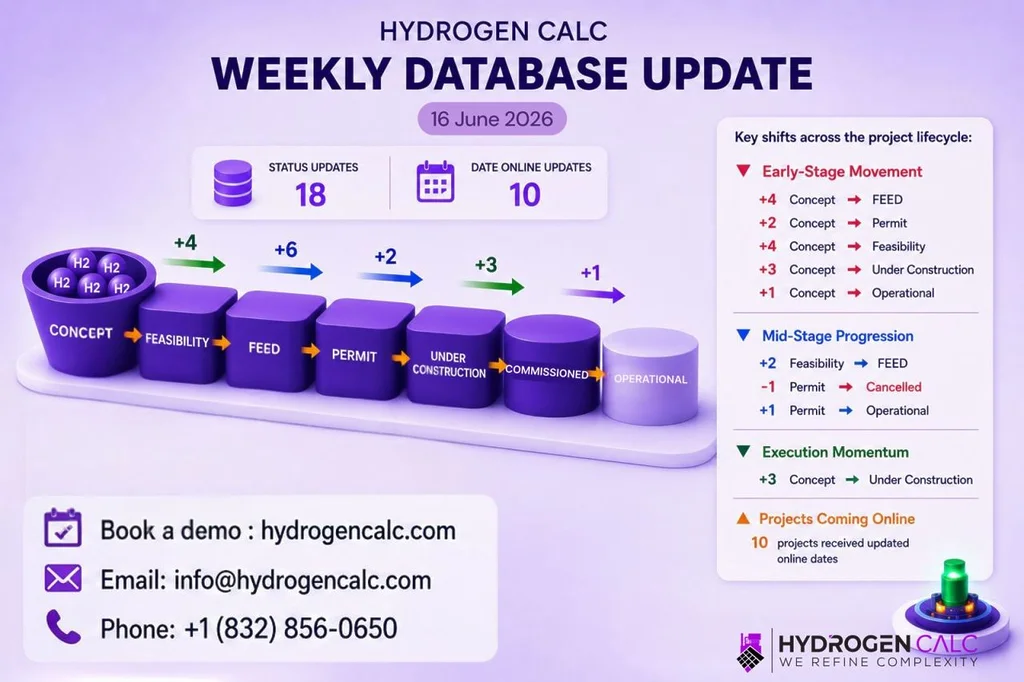
This week’s HydrogenCalc database update recorded 18 project status changes and 10 updated online dates, offering a useful snapshot of how the global hydrogen market is progressing. The clearest signal is that early-stage activity remains highly active, with several projects moving out of concept and into more advanced development phases.
Four projects advanced from concept to FEED, while another four moved from concept to feasibility. This suggests that developers are continuing to refine project plans, test commercial assumptions, and move selected opportunities toward more detailed technical and financial evaluation. FEED-stage movement is especially important because it often indicates that a project is becoming more serious, structured, and closer to investment or execution decisions.
The update also showed three projects moving directly from concept to under construction. While this is less common, it highlights that some projects are advancing quickly where development conditions are strong. These may include projects with clearer offtake, stronger policy support, better access to infrastructure, or more mature sponsor backing.
At the same time, one project moved from concept to operational status, and another moved from permit to operational. These transitions show that the hydrogen sector is not only generating announcements but also delivering real project progress. Operational movement remains a key signal for market participants because it helps separate active delivery from long-term ambition.
However, the market is still facing challenges. One project moved from permit to cancelled, showing that even relatively advanced projects can still be affected by financing pressures, permitting issues, cost changes, or shifting commercial priorities.
The 10 updated online dates are also significant. Timeline revisions suggest that developers are continuing to adjust expectations as project realities evolve. For the hydrogen market, this reinforces the importance of tracking project movement over time rather than relying only on headline announcements.
Overall, this week’s data points to a hydrogen project pipeline that is still advancing, especially at the early stage, while also becoming more selective. The strongest projects appear to be moving toward FEED, construction, and operation, while others continue to face delays, revisions, or cancellation risk.
Source: HydrogenCalc (LinkedIn)