China hydrogen market developments are often viewed through the lens of large-scale production projects, electrolysers and hydrogen infrastructure. However, recent commentary from industry observers suggests another trend may also be emerging: a growing focus on the products and technologies that could ultimately create hydrogen demand.
Writing recently on China’s hydrogen sector, Jian Wu, founder and editor of China Hydrogen Bulletin, highlighted new listing rules for Shanghai’s STAR Market that are designed to improve access to capital for technology-focused companies. Hydrogen energy was specifically identified as one of the strategic industries expected to benefit from the reforms.
According to Wu, the changes could make it easier for hydrogen technology companies to raise funds and accelerate innovation across the sector.
At the same time, a separate observation from Sanjeev Sharma, Vice President of Business Development & Strategy at GH2 Solar, points to another potentially important development within the China hydrogen market.
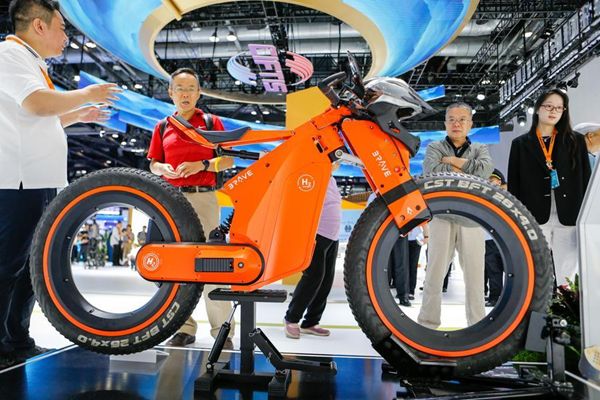
Commenting on the announcement that a Chinese company had reportedly secured approximately US$300 million in overseas orders for hydrogen-powered motorcycles, Sharma suggested that the significance of the story may extend beyond the vehicle itself.
The motorcycle, developed by Beijing Juzhi Hezhong Technology, uses solid-state hydrogen storage technology and a swappable hydrogen tank system, with the company reportedly planning production capacity of up to 200,000 units per year.
For years, much of the global hydrogen conversation has focused on the supply side of the industry. Governments, developers and investors have concentrated on electrolysers, renewable power projects, hydrogen production facilities, refuelling stations and export infrastructure.
While these investments remain essential, the industry continues to face a familiar challenge: creating sufficient demand for the hydrogen being produced.
Sharma’s observation raises an interesting question. Could China be placing greater emphasis not only on building hydrogen supply chains, but also on developing products that create hydrogen demand?
The motorcycle announcement alone does not signal a market transformation. However, it may provide a useful example of how some Chinese companies are approaching hydrogen commercialisation. Rather than focusing exclusively on production capacity, they are also exploring products that can consume hydrogen and potentially create new end-user markets.
This approach would be consistent with China’s development of other clean energy industries. In sectors such as solar photovoltaics, batteries and electric vehicles, success was built not only on manufacturing capacity but also on the commercialisation of finished products for domestic and international markets.
Whether hydrogen-powered motorcycles become a significant market remains uncertain. Nevertheless, the example highlights a broader issue facing the global hydrogen sector. Future growth may depend not only on producing more hydrogen, but also on creating practical applications capable of generating sustained demand.
If so, the real significance of the motorcycle may lie less in the vehicle itself and more in what it hints at about the future direction of the China hydrogen market.
Source: Jian Wu, Founder & Editor, China Hydrogen Bulletin (“Hydrogen-powered Two-wheel Motorcycle Sees Explosive Global Orders” and related commentary on China’s hydrogen sector); Sanjeev Sharma, Vice President of Business Development & Strategy, GH2 Solar (LinkedIn commentary on hydrogen-powered motorcycles and hydrogen demand creation in China).