Green hydrogen cost can reach the levels the market needs if renewable electricity access and electrolyser performance improve together.
Can we produce green hydrogen at the cost we need? Yes, we can!
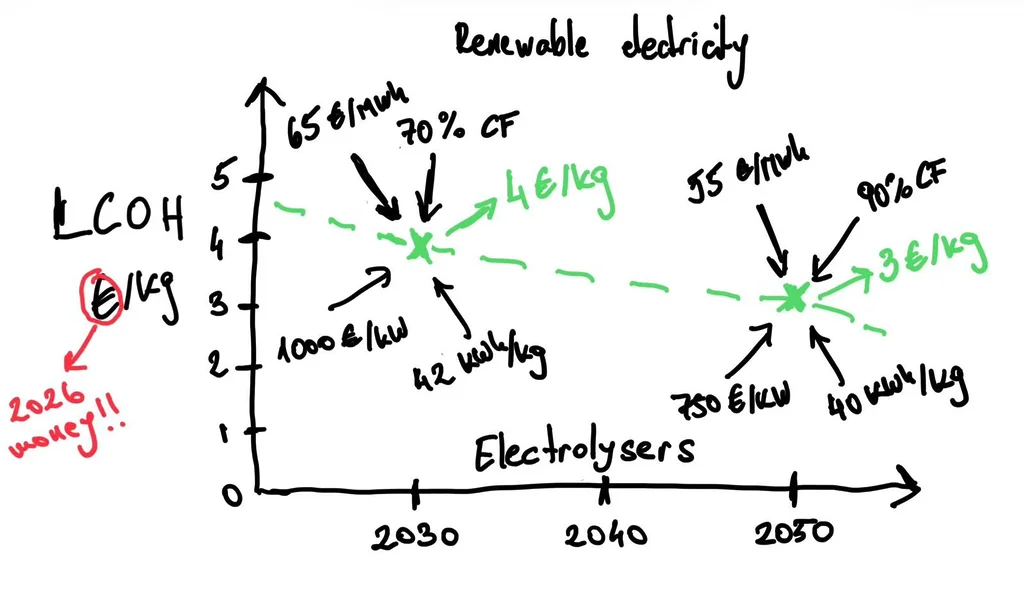
I have been carefully explaining the importance of LCOH and understanding how it is built. Thanks to this understanding, we can create scenarios like the one shown in the graph to establish some targets.
To start this work, it is important to agree on the LCOH levels that we want to achieve. Everyone in the H2 community would be very happy if we find a way to produce green H2 at 4 €/kg by 2030 and 3 €/kg by 2050, considering that we are talking in 2026 money values. Therefore, the 2050 value would be well below the current 2 €/kg in today’s money.
Coming back to LCOH and the factors that affect it the most, the parameters that have the greatest influence on LCOH are access to renewable electricity, reflected in both the electricity price and the capacity factor (how many hours per year renewable electricity is available), as well as electrolyser system performance and cost. By playing with these parameters, we can establish two different scenarios for 2030 and 2050, keeping in mind what is realistically achievable.
2030 scenario
In this scenario, the first parameters to lock in are those related to renewable electricity. This is linked with the availability of renewable electricity. We all know that not everyone will have broad access to renewable electricity by 2030, and therefore a relatively high electricity price and a lower capacity factor (CF) should be considered. However, the CF must be high enough; otherwise, the pressure on electrolysis will be too high.
In this case, a 70% CF (~6,000 hours/year) and 65 €/MWh are considered. By locking in these parameters and adjusting the CAPEX and OPEX of the electrolyser, values of 1000 €/kW and 42 kWh/kg are obtained.
This means that technologies must be both efficient and relatively low cost by 2030. Remember: CAPEX and OPEX values are always given for a complete H2 plant, not only the electrolyser.
2050 scenario
Here, it is logical to think that renewable electricity will have become more widely available, and therefore CF close to 90% could be achieved. In terms of electricity prices, we do not need to be overly aggressive, allowing producers to maintain reasonable margins and keep their business sustainable. Therefore, I have chosen to lock in 55 €/MWh together with a 90% CF.
When we then consider the electrolyser parameters, reducing CAPEX and OPEX to achieve 3 €/kg is quite reasonable, resulting in approximately 750 €/kW and 40 kWh/kg, respectively.
In conclusion, understanding all the parameters that affect LCOH and how we can fine-tune them to achieve the target values is key at this point.
This analysis shows that developing highly efficient technologies will be essential to achieving low LCOH values, without disregarding the cost and the impact of renewable electricity availability and price.
Source: Carlos Bernuy-Lopez (LinkedIn)