The hydrogen project pipeline is becoming more selective, with this week’s HydrogenCalc update showing both contraction at the front end and progress in execution-stage projects.
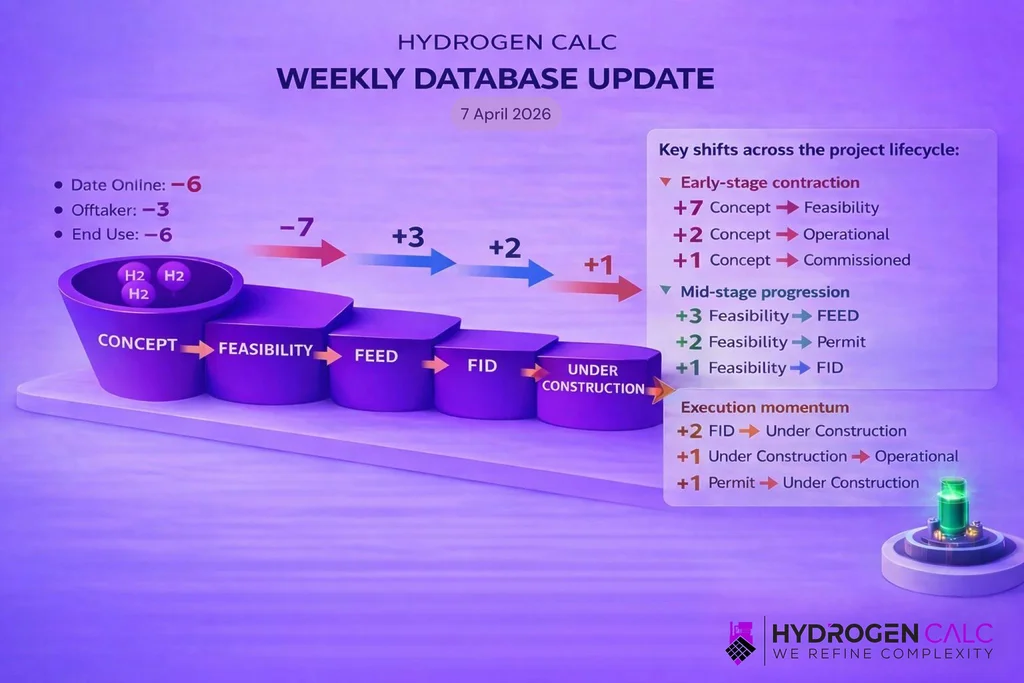
The latest weekly update from HydrogenCalc offers a revealing snapshot of how the global hydrogen market is evolving. Rather than showing broad-based expansion, the newest database changes point to a hydrogen sector that is filtering more aggressively—trimming weaker early-stage activity while allowing more credible projects to move forward.
This week’s update recorded a net reduction of 54 project records, alongside declines in key data points including online dates, offtaker information, and end-use classifications. On the surface, that may appear negative. In practice, however, it reflects something more important: a clearer and more disciplined view of where projects actually stand in the development cycle.
The biggest weakness appeared at the earliest stages of the market. Several projects moved out of concept status, including a notable drop in concept-to-feasibility transitions and additional reductions tied to projects previously categorized as operational, commissioned, or moving toward final investment decision. That pattern suggests a tightening market in which early announcements and speculative developments are being reassessed more critically.
At the same time, the mid-stage project base showed encouraging signs. Multiple projects advanced from feasibility into FEED, permitting, and FID-related milestones. These movements suggest that the market is still progressing where developers have stronger fundamentals, better project design, or a clearer path to financing and approvals.
Execution-stage activity also remains active. Projects continued to move from FID into construction, while others advanced from construction into operational status. Another permit-stage project also moved into construction, reinforcing the idea that real momentum still exists beyond the headline noise of announcements and pipeline inflation.
Taken together, these shifts highlight an increasingly important distinction in the hydrogen market: the difference between nominal project volume and credible project advancement. As the sector matures, decision-makers need more than headline counts. They need visibility into which projects are truly progressing, which are stalling, and which have been reclassified as assumptions give way to execution realities.
That is why weekly lifecycle tracking matters. For investors, policymakers, and commercial teams, understanding the hydrogen project pipeline at a granular level is becoming essential to making better strategic decisions in a market that is no longer just growing—it is being refined.
Source: HydrogenCalc (LinkedIn)