
Hydrogen production costs continue to vary significantly across global markets, highlighting the challenges facing the development of a competitive international hydrogen economy.
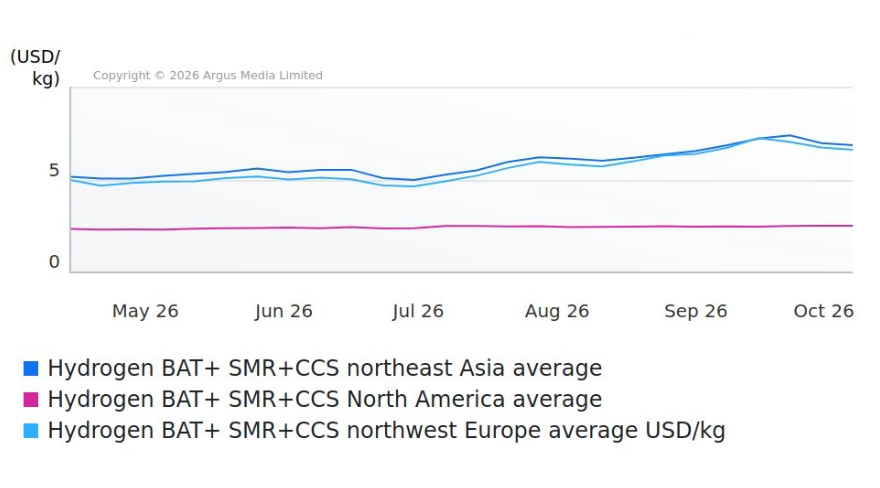
Recent cost indices published by Argus Media illustrate the differences between North America, Europe, northeast Asia and the Middle East, particularly for hydrogen produced from natural gas using carbon capture and storage (CCS).
European and Asian production costs remain elevated
Hydrogen produced through steam methane reforming (SMR) with CCS shows broadly similar cost trends in northwest Europe and northeast Asia.
Both regions experienced rising production costs between July and early October 2026, with indicative costs climbing above $6/kg before easing slightly.
North American production costs, meanwhile, remained considerably lower and relatively stable, at approximately $2/kg.
Alternative technologies reveal further regional differences
The second dataset examines low-carbon hydrogen produced using autothermal reforming (ATR) with CCS.
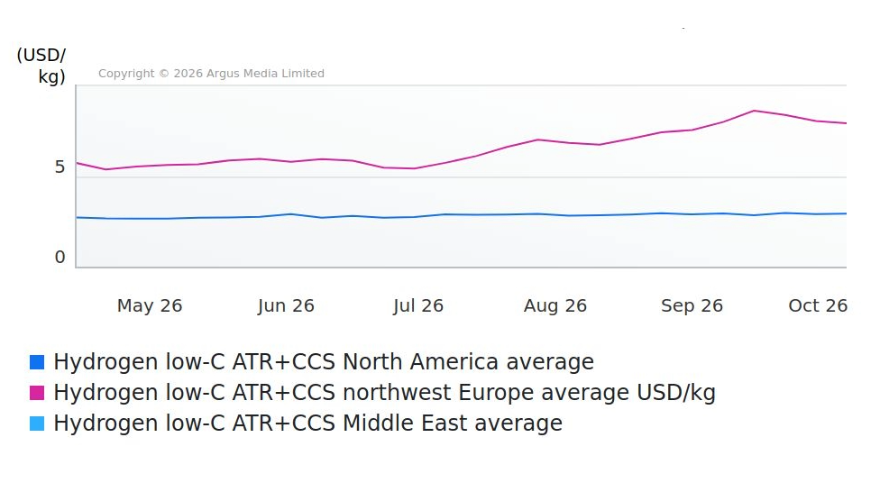
Here, northwest European production costs increased from approximately $5/kg in April to above $7/kg by early October.
By comparison, North American and Middle Eastern production costs remained significantly lower, at approximately $2–3/kg.
What does this mean for hydrogen markets?
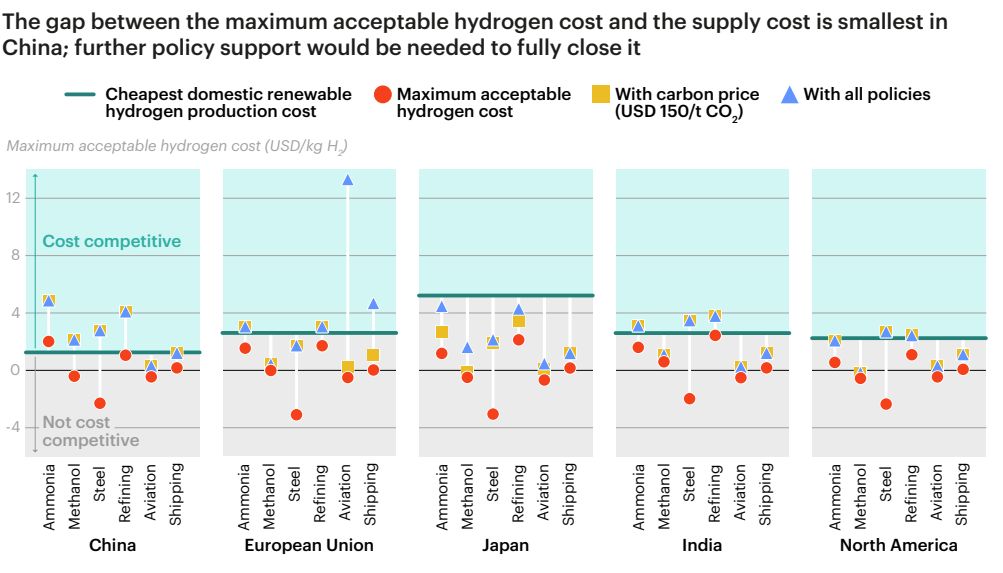
These regional differences underline one of the central challenges facing the hydrogen industry: achieving cost competitiveness while developing production capacity and international supply chains.
For European hydrogen buyers, the figures also reinforce the potential importance of imports from lower-cost producing regions.
Source: Argus Media, Hydrogen Cost Indices, October 2026.